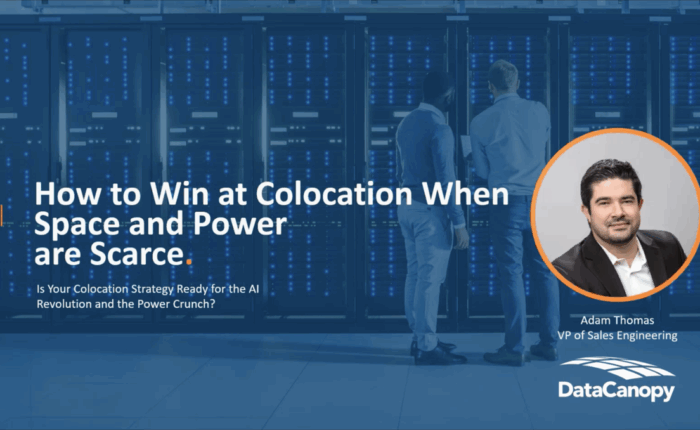
If you missed our recent webinar with Andrew Jannot, EVP of Sales, and Adam Thomas, VP of Sales Engineering at Data Canopy, here’s a comprehensive recap of the key insights. The full recording is embedded below.
TL;DR
Colocation pricing has fundamentally changed. Three forces — private equity acquisitions, AI demand spilling into retail environments, and severe power constraints — have created a market where prices have doubled in under two years and only ~3% of U.S. inventory remains available. The old playbook of waiting for a good deal no longer works. Smart buyers are locking in capacity early, right-sizing their power commitments, and looking at secondary markets before inference demand drives those prices up too.
The Market Has Shifted — Here’s Why It Matters
Two years ago, colocation pricing across the U.S. was relatively predictable. The same operator charged roughly the same rate whether you were in Denver, Dallas, or Virginia. That world is gone.
Today, three converging forces are reshaping the economics of colocation for every buyer — even those who aren’t running AI workloads.
1. Capital Markets Changed the Rules
Private equity and institutional investors — KKR, Blackstone, BlackRock, JPMorgan — have always played in the data center space. But the AI-driven surge in demand triggered an acquisition wave that fundamentally changed how operators price their inventory.
The old model: Fill the building. Standard pricing across the portfolio.
The new model: Maximize revenue per kilowatt. Price each facility individually based on occupancy.
This shift to demand-based pricing means the same operator, with the same SLA, can charge vastly different rates at two different locations. Andrew shared a real example from Q4 2025: one facility in Kentucky at 95% capacity charged $220/kW, while a comparable facility down the street at 40% capacity charged $140/kW.
The Investment Wave by the Numbers
The scale of capital flowing into data center infrastructure is staggering:
| Metric | Figure |
|---|---|
| U.S. data center investment in 2025 | $425B+ (~70% from hyperscalers) |
| Largest single DC acquisition | $40B (Microsoft/Aligned Data Centers) |
| Global infrastructure need through 2030 | $7 trillion |
| Construction cost increase since 2021 | +53% |
| Transformer lead times | 44+ weeks (up from pre-2020 norms) |
| Transformer cost increase (3 years) | +70% |
These numbers illustrate why having available power to sell today is so valuable. If lead times for critical infrastructure like transformers exceed 44 weeks, building new capacity isn’t a quick fix.
2. AI Isn’t Just a Hyperscale Story Anymore
The first wave of AI demand was confined to massive hyperscale deployments — 5 MW, 10 MW, 25 MW training clusters. Those workloads didn’t directly compete with typical retail colocation customers.
That’s changing fast.
As AI shifts from training to inference, the deployment profile is evolving. Inference workloads are smaller, more distributed, and increasingly landing in retail colocation environments. Deployments of 300–500 kW — the same size as many enterprise retail customers — are now competing for the same shrinking inventory.
How quickly this shifted:
- Average AI cluster size in early 2024: ~6 MW
- Average AI cluster size today: ~20 MW
- Individual pod size: grew from 800 kW to 1,600 kW in a single year
Adam emphasized the critical distinction: training models drove the first wave of demand (centralized, hyperscale). Inference requires geographic distribution for low latency — which means inference deployments will increasingly show up in the same facilities where retail customers operate.
The bottom line: retail colocation customers now compete with AI companies for the same power and space. And operators will sell to whichever tenant pays more.
3. Pricing Has Doubled in Key Markets
The combined effect of PE-driven demand pricing and AI absorption has hit retail colocation pricing hard.
| Market | 2022 Price | 2026 Price | Notes |
|---|---|---|---|
| Dallas/DFW | ~$100/kW | ~$220/kW | 100%+ increase in under 2 years |
| Northern Virginia | — | $180–$220+/kW | 0.72% vacancy; preleasing into 2027+ |
| Silicon Valley | — | Up to $450/kW all-in | Highest cost market in the U.S. |
| Chicago | — | Rising 14.7% YoY | Hyperscaler + enterprise demand surge |
Important nuance: These are base rates, not all-in costs. Once you factor in metered power usage, you’re adding $100–$150/kW on top. In Silicon Valley, that pushes total costs above $450/kW.
Secondary Markets: A Closing Window
Secondary markets still offer 15–30% lower pricing than primary markets. But that gap is narrowing fast as inference demand pushes AI workloads toward regional distribution.
| Secondary Market | Status |
|---|---|
| Atlanta | ~$120/kW — most affordable among major markets |
| Columbus, OH | Not yet at primary pricing, but drawing hyperscaler interest |
| Salt Lake City | $150–$200/kW range |
| Austin/San Antonio | Below DFW, benefiting from ERCOT speed-to-power |
Andrew noted that Data Canopy just secured a new partnership in the Chicago market with 500 kW of aggressively priced capacity — the kind of deal that’s possible because of 16 years of operator relationships and pre-purchased inventory.
4. What Smart Buyers Are Doing Now
The old playbook — waiting for a good renewal offer, running month-to-month, or going direct to operators without a market view — no longer works in a seller’s market. Here’s what’s replacing it.
Lock In Capacity Early
Reserve space 6–12 months before deployment, even before your hardware is ready. Data Canopy sold approximately 450 of its 600 kW starting inventory within Q1 alone. Available capacity moves fast.
Right-Size Your Power
Many customers use only 10–17% of their committed power. That’s wasted money. An analysis of actual power usage — and negotiating power whip swaps — can offset rate increases significantly. As Adam put it: “If your price goes up 40% but you’re using 60% less power than you committed to, you’re actually saving 20%.”
Extend Your Planning Horizon
Shift from 1-year to 3+ year capacity planning. If you had locked in a 3% annual escalator three years ago, you’d still be paying 94% less than today’s market rate increase.
Evaluate Secondary Markets Strategically
Not as a backup — as a deliberate cost play. Lock in secondary market rates before inference demand arrives and closes the pricing gap.
Watch Your Contract Terms
Two contract terms carry the most risk:
- CPI-linked escalators — Highly variable depending on inflation. Push for fixed escalators instead.
- Early termination fees — A 100% ETF means you’re on the hook for the full contract value from day one. A declining schedule (75% / 50% / 25% over three years) dramatically reduces financial risk, especially during M&A.
How Data Canopy Navigates This for Customers
Data Canopy has been in the colocation resale business for over 16 years. That longevity creates a structural advantage in today’s market:
- Pre-purchased capacity across multiple operators (CyrusOne, NTT, Digital Realty, DataBank) at rates negotiated years ago
- Access to top-tier data centers for sub-megawatt deals that many operators won’t entertain directly
- One contract, one relationship — simplifying procurement across 9+ markets nationwide
- Right-sizing expertise — helping customers analyze actual power usage and avoid overcommitment
As Andrew put it: “While a lot of operators don’t have available power to sell at favorable rates, we still do — because we purchased it years ago on long-term commitments.”
FAQ
How much has colocation pricing increased?
In key markets like Dallas, retail colocation pricing has roughly doubled in under two years — from ~$100/kW in 2022 to $220/kW today. Primary markets like Northern Virginia and Silicon Valley are even higher.
Why are AI workloads affecting retail colocation customers?
AI is shifting from large-scale training (hyperscale deployments) to inference (smaller, distributed workloads). Inference deployments of 300–500 kW compete directly with traditional retail customers for the same inventory.
What’s the current vacancy rate for U.S. colocation?
Approximately 3% of U.S. colocation inventory is available, with 75% of new capacity under development already pre-leased.
Should I lock in colocation capacity now or wait?
Lock in now. Capacity is being absorbed faster than it can be built. Transformer lead times alone exceed 44 weeks, and new facilities take years to bring online. Waiting means paying more — or not finding space at all.
How can I reduce my colocation costs without switching providers?
Start with a power utilization analysis. Many customers commit to far more power than they use. Right-sizing your power commitment and negotiating whip swaps can significantly reduce your monthly bill.
Are secondary markets a good alternative to primary markets?
Yes — secondary markets like Atlanta, Columbus, and Salt Lake City still offer 15–30% savings. But that window is closing as AI inference workloads push toward geographic distribution.
Secure Your Capacity Before It’s Gone
The colocation market rewards buyers who act early and plan ahead. If you’re evaluating colocation, approaching a renewal, or wondering whether your current footprint can expand — now is the time to have that conversation.
Explore current availability across our data center locations
Or reach out directly:
- Andrew Jannot, EVP of Sales — ajannot@datacanopy.com
- Adam Thomas, VP of Sales Engineering — athomas@datacanopy.com